You can obtain the later PMP Handbook from the link below:
Showing posts with label PMP Study Tips. Show all posts
Showing posts with label PMP Study Tips. Show all posts
Sunday, October 4, 2015


Saturday, July 21, 2012
Get a free eBook - The Short Guide to Becoming A PMP
Get a free eBook,The Short Guide to Becoming A PMP. See what it takes to prepare for the Exam.
http://www.pm-prepcast.com/free-- PMP® Exam Tips (@PMExamTips)
http://www.pm-prepcast.com/free-- PMP® Exam Tips (@PMExamTips)
Saturday, July 14, 2012
What are the 4 types of breakdown structures defined in PMBOK?
The 4 types of breakdown structures are:
- Organizational breakdown structure
- Resource breakdown structure
- Risk breakdown structure
- Work breakdown structure
Saturday, September 10, 2011
PMBOK 5th Edition is Underway
According to PMI, the 5th edition of the PMBOK is underway:
So far, we have not been given much information on what will be the change and what will be included in the latest exam. If anyone who has such information, please share with all of us in this site.
Saturday, October 17, 2009
PMP Exam: The 5 Secret Keys to PMP Exam Success
I received the following tips from PMP Exam Resources and I believe this will benefit all of you.
--------------------------------------------------------------
http://webmasterstreasure.com/recommends/pmp5secrets
Dear Group Member,
"How to Ace the Project Management Professional (PMP) Credential Examination, using easy step-by-step PMP
test study guide, without weeks and months of endless studying..."
Before we go any further, let me clarify what PMP Exam Secrets is not. It is not a stale rehash of all of the things you have already learned.
PMP Exam Secrets is our exclusive collection of tips and information specially selected to give you the best results on the PMP test for the least time spent studying. It's written in everyday language and is easy to use.
We cover the 5 essential skills necessary to do well on the PMP test, plus comprehensive reviews covering all the essential test sections individually.
Warning: Always Look for These 6 Criteria
There is a lot of confusion surrounding studying for the PMP test, and standardized tests in general. In our opinion, these are the 6 criteria you should always look for in a study guide for the PMP test:
One: It must be written by writers who have painstakingly researched the topics and concepts needed to succeed on the PMP test. The blind cannot hope to lead the blind.
Two: It must be written in easy-to-use everyday language so all test takers can access the information.
Three: It should be to-the-point, with no fluff to distract the test taker from the truly important information.
Four: It must address the test first, the material second. If the material was the only thing that was important, then every test taker that understood he material should get a perfect score- that doesn't happen because there's a difference between simply knowing what's on the test and test performance. You want a study guide to close that gap.
Five: It must motivate the test taker to actually study. If it's hard to read, studying is slow and painful, and will produce meager results.
Six: The guide must be guaranteed- if you don't pass with flying colors, you get your money back-no questions asked. You get at least 10 times your money's worth!
When you consider what's at stake with your exam, we believe the value of our study guide gives you at least ten times your money's worth.
In summary, here's what you get:
When you buy PMP Exam Secrets, it includes-
The 5 Secret Keys to PMP Exam Success:
* Time is Your Greatest Enemy
* Guessing is Not Guesswork
* Practice Smarter, Not Harder
* Prepare, Don't Procrastinate
* Test Yourself
Learn More at
http://webmasterstreasure.com/recommends/pmp5secrets
Friday, March 6, 2009
PMBOK 3rd Edition or 4th Edition?
This is a very good article in PM-Best.com on which PMBOK you should refer to for the exam. It is very informative and worth a read. You can find the information in the link below:
Saturday, October 25, 2008
One Page Formula's for PMP Exam
From PMP Exam Resource, I have received the following email that I believe will be very valuable before taking PMP exam.:
Q U A L I T Y
-------------
CoQ = ( ( Review Efforts + Test Efforts + Training Efforts + Rework Efforts + Efforts of Prevention) / Total Efforts) x 100 %
PERT = O + 4ML + P
--------------
6
MEAN -> Average
MODE -> The "most found" number
RANGE -> Largest - Smallest Measure.
MEDIUM -> No in the middle or avg. of 2 middle Nos
STD. DEV. OF TASK = P - O
____________
6
TASK VAR. = (P - O) 2 = Std. Dev ^ 2
____________
6
_____________
CP STD. DEV. = √ σ² + σ² + σ²
SIGMA 1 = 68.26
2 = 95.46
3 = 99.73
6 = 99.99
Channels of Communication
-------------------------
COMM = (N2 - N) / 2 = (N x (N - 1)) / 2
P R O J E C T S E L E C T I O N
---------------------------------
PV = F V .
-------
(1+r)ⁿ
FV = PV x (1+r)
NPV = S ( PV + PV + PV + PV )
---- ---- ---- ----
(1+r)ⁿ (1+r)ⁿ (1+r)ⁿ (1+r)ⁿ
Cash Flow = Cash Inflow - Cash Outflow
Discounted Cash Flow = CF x Discount Factor
ARR = S Cash Flow / No. of Years
ROI = (ARR / Investment) * 100 %
BCR = Benefits / Cost
Exp. Value = Probability % x Consequence $
Class of Estimates
-------------------
Definitive +5%
Capital Cost +10-15%
Appropriation +15-25%
Feasibility +25-35%
Order of Magnitude > +35%
Contract Incentives
--------------------
Savings = Target Cost - Actual Cost
Bonus = Savings x Percentage
Contract Cost = Bonus + Fees
Total Cost = Actual Cost + Contract Cost
E A R N E D V A L U E A N A L Y S I S
---------------------------------------------
PV (Present Value) = BCWS (Budgeted Cost of Work Schedule)
EV (Earned Value) = BCWP (Budgeted Cost of Work Performed)
AC (Actual Cost) = ACWP (Actual Cost of Work Performed)
CV = EV - AC
CPI = EV / AC (efficiency)
SV = EV - PV
SPI = EV / PV
ETC = BAC - EV or (BAC - EV) / CPI
EAC = AC + ETC
EAC = BAC / CPI
VAC = BAC - EAC
% COMPLETE = EV / BAC x 100
% SPENT = AC / BAC x 100
CV% = CV / EV x 100
SV% = SV / PV x 100
------------------------------------------------------------
Sunday, October 12, 2008
General PMP Exam Tips
General tips - obtained from "PMP Exam Resource"
- You should memorize all formulas, especially the Earned Value and PERT.
- Practice eliminating the completely implausible options first.
- There is no penalty for guessing; thus, do not leave any question blank.
- There will always be those situations where you have no idea what the question is asking.
- Use educated guessing to select the most appropriate option. Remember, you have only 80 seconds for each question. If you do not know the answer of a question, mark it and move on and revisit it later if you have time.
- Answer the questions based on the PMBOK concepts first, then consider your experience.
- If they are in conflict, the PMBOK wins.
PMI Concept Oriented Tips
PMI concept-oriented tips - (obtained from "PMP Exam Resource")
- The project manager takes an active approach to the job by not waiting until a risk materializes and becomes a problem. This is an extremely important concept that might affect many questions on an exam. The project manager does not escalate problems to upper management or to the customer before fully analyzing them and identifying options.
- When answering a question related to what the project manager should do in a specific situation, you should rephrase the question to: What is the first thing the project manager will do given such a situation and given his or her proactive nature?
- Assume that lessons learned and historical databases are available. This might not be true in a real life situation.
- PMI does not approve adding extra functionality without benefits or gold plating.
Project managers have all kinds of soft and hard skills. - The Work Breakdown Structures (WBSs) are wonderful tools.
- Roles and responsibilities need to be properly defined.
Tips for taking the PMP exam (Part 2)
Tips for taking the PMP exam (Part 2) - (obtained from "PMP Resources")
Passing the PMP exam requires extensive preparation. Use the following tips and techniques as part of that preparation, which should also include developing a comprehensive understanding of the PMBOK concepts and terminology, practicing previous exam questions when possible, and attending a few project management-training courses.
Question-oriented tips
- There are certain questions that contain extra information. This information is irrelevant and it does not relate to the correct answer. Beware of such questions and remember it isn't necessary to use all the information provided to answer the question.
- Each question has only one correct answer. You need to select the most appropriate answer. Beware of choices that represent true statements but are not relevant. Be sure to read all the options before you select any one.
- You need to answer the questions from a PMI perspective—not from your own perspective, which you acquired through experience. Remember that PMI is trying to present an ideal environment for project managers that might be different from your own experience.
- Beware of answer choices that represent generalizations, which may be characterized by words such as always, never, must, or completely; these are often the incorrect choices.
- Look out for choices that represent special cases. These choices tend to be correct and are characterized by words such as often, sometimes, may, generally, and perhaps.
- The correct answer may not be grammatically correct.
Tips on taking the PMP exam (Part 1)
Tips on taking the PMP exam (taken from "PMP Exam Resource")
The PMP certification examination is a computer-based exam that is offered at PMI locations in the United States, Canada, and in other countries worldwide.
The exam is based on information from the entire project management body of knowledge. The Guide to the Project Management Body of Knowledge” (PMBOK), which is published by PMI, provides an outline of the topics covered.
Because the exam is computer based, participants can find out how they scored by reading the detailed report on performance that is available when the exam is completed. Questions on the PMP exam are grouped by project management processes. The basic PMP exam is not industry specific. The PMI Certificate of Added Qualification (CAQ), which tests your knowledge of a particular industry, can be added to certify your expertise in Information Technology Project Management, Establishing a Project Management Office, and Project Management in the Automotive Industry.
Saturday, March 1, 2008
Tips and tricks in getting my PMP (useful for CAPM too!)
I was reading the lesson learned section in the PMHub Forum and found a very good article by elceem on the tips and tricks in getting PMP. I have extracted the iformation below:
Tips & Tricks in getting your PMP
- treat this as a project: today is your start day and decide a target finish date
- become a member of PMI – its is cheaper this way (read FAQ)
- register on line and get your approval to write PMP exam within 3 days (read FAQ)
- call your exam center and get an exam day
- get hold of a PMP mock test and record down your score on each knowledge area (try PMHUB Question Bank in PMHUB Forums)
- record your weak “knowledge area”
- check the literatures to read for PMP (check FAQ) and its review in PMHUB
- Read the PMBOK last, study other materials first: JIMBOK & Eric's Lunch Time Lecture at PMHUB.net
- Use the PDF version of PMBOK and do your searches there 9b) use a SEARCH engine on the web, do not be lazy - get your own answer - no pain no gain
- important to know your own effective study style (do not just follow somebody’s advice to memorize ITTO)
- go through the exam exercises as much as you can, use the PMP/CPAPM Daily Tips
- study all the PMIism and for the exam's sake try to believe in them
- visit the exam center several days before the exam, get familiar with the area
- get a good rest 2-3 days before the exam
- during the exam: stay calm and after 10 minutes or so you will get your rhythm
- always choose the best answer for all the possible right answer, eliminate those that are wrong
Your exam dogma: PMIism
- Gold plating is a sin
- PM skills is transferable to any industry, you do not need industry-related skills
- Confrontation is the best way in conflict resolution
- PM is the most important job in the world
- WBS WBS WBS
- PM is proactive
- Scope, roles and responsibilities need to be clearly defined
Original link:
Thursday, November 29, 2007
Some Earned Value Formulas - From PMP Resource (for your PMP exam preparation)
The following are extracted from "PMP Resources":
The PMP exam is big on terminology. These are the basic Earned Value Terms you need to know. If you are studying to pass the PMP exam you should know these by heart and be able to derive them in case you are heartbroken. They really are fairly simple. In order from first to last:
BAC = Budget at Completion (Project budget)
AC = Actual Cost of the Work Performed
EV = Earned Value
EV = Budgeted Cost of the Work Performed
EV = % complete times BAC
PV = Planned Value
PV = Budgeted Cost of the Work Scheduled
CV = Cost Variance
CV = EV – AC
CPI = Cost Performance Index
CPI = EV/AC
SV = Schedule Variance
SV = EV – PV
SPI = Schedule Performance Index
SPI = EV/PV
EAC = Estimate at Completion
EAC = BAC/CPI
ETC = Estimate to Complete
ETC = EAC – AC
VAC = Variance at Completion
VAC = BAC – EAC
Note that the acronyms are slightly different from what was used a few years ago and is still widely used by old timers. PMI simplified the terms by dropping a letter here and there. The fundamentals are the same though.
You can also refer to http://groups.google.com/group/PMP-Preparation.
Wednesday, October 10, 2007
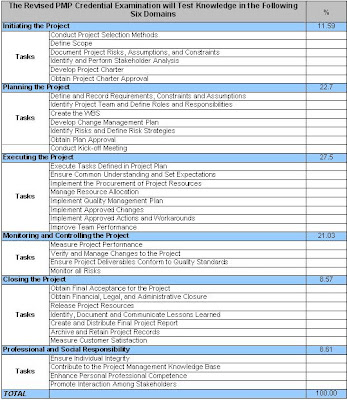
Revised PMP Credential Examination Test Knowledge Areas - for PMP Exam Preparation
I have recently received the following information on the revised PMP credential examination test knowledge areas and I have enclosed the new figures below (please click on the picture to enlarge the picture). You may want to review how this may affect your preparation for your test.

Saturday, October 6, 2007
PMP Examination Preparation Tips
I have received a mail from PMP-Preparation goole group on tips to take the PMP exam. I found that it is a very good article and I would like to share this with you. For more information, please refer to PMP-Preparation Group at the link below:
http://groups.google.com/group/PMP-Preparation
Tips on taking the PMP exam
The PMP certification examination is a computer-based exam that is offered at PMI locations in the United States, Canada, and in other countries worldwide.The exam is based on information from the entire project management body of knowledge. The “Guide to the Project Management Body of Knowledge” (PMBOK), which is published by PMI, provides an outline of the topics covered.
Because the exam is computer based, participants can find out how they scored by reading the detailed report on performance that is available when the exam is completed.
Questions on the PMP exam are grouped by project management processes.The basic PMP exam is not industry specific. The PMI Certificate of Added Qualification (CAQ), which tests your knowledge of a particular industry, can be added to certify your expertise in Information Technology Project Management, Establishing a Project Management Office, and Project Management in the Automotive Industry.Tips for taking the PMP examPassing the PMP exam requires extensive preparation. Use the following tips and techniques as part of that preparation, which should also include developing a comprehensive understanding of the PMBOK concepts and terminology, practicing previous exam questions when possible, and attending a few project management-training courses.
Question-oriented tips
PMI concept-oriented tips
http://groups.google.com/group/PMP-Preparation
Tips on taking the PMP exam
The PMP certification examination is a computer-based exam that is offered at PMI locations in the United States, Canada, and in other countries worldwide.The exam is based on information from the entire project management body of knowledge. The “Guide to the Project Management Body of Knowledge” (PMBOK), which is published by PMI, provides an outline of the topics covered.
Because the exam is computer based, participants can find out how they scored by reading the detailed report on performance that is available when the exam is completed.
Questions on the PMP exam are grouped by project management processes.The basic PMP exam is not industry specific. The PMI Certificate of Added Qualification (CAQ), which tests your knowledge of a particular industry, can be added to certify your expertise in Information Technology Project Management, Establishing a Project Management Office, and Project Management in the Automotive Industry.Tips for taking the PMP examPassing the PMP exam requires extensive preparation. Use the following tips and techniques as part of that preparation, which should also include developing a comprehensive understanding of the PMBOK concepts and terminology, practicing previous exam questions when possible, and attending a few project management-training courses.
Question-oriented tips
- There are certain questions that contain extra information. This information is irrelevant and it does not relate to the correct answer. Beware of such questions and remember it isn't necessary to use all the information provided to answer the question.
- Each question has only one correct answer. You need to select the most appropriate answer. Beware of choices that represent true statements but are not relevant. Be sure to read all the options before you select any one.
- You need to answer the questions from a PMI perspective—not from your own perspective, which you acquired through experience. Remember that PMI is trying to present an ideal environment for project managers that might be different from your own experience.
- Beware of answer choices that represent generalizations, which may be characterized by words such as always, never, must, or completely; these are often the incorrect choices.
- Look out for choices that represent special cases. These choices tend to be correct and are characterized by words such as often, sometimes, may, generally, and perhaps.
- The correct answer may not be grammatically correct.
PMI concept-oriented tips
- The project manager takes an active approach to the job by not waiting until a risk materializes and becomes a problem. This is an extremely important concept that might affect many questions on an exam. The project manager does not escalate problems to upper management or to the customer before fully analyzing them and identifying options. When answering a question related to what the project manager should do in a specific situation, you should rephrase the question to: What is the first thing the project manager will do given such a situation and given his or her proactive nature?
- Assume that lessons learned and historical databases are available. This might not be true in a real life situation.
- PMI does not approve adding extra functionality without benefits or gold plating.
- Project managers have all kinds of soft and hard skills.
- The Work Breakdown Structures (WBSs) are wonderful tools.
- Roles and responsibilities need to be properly defined.
General tips
- You should memorize all formulas, especially the Earned Value and PERT.
- Practice eliminating the completely implausible options first.
- There is no penalty for guessing; thus, do not leave any question blank.
- There will always be those situations where you have no idea what the question is asking.
- Use educated guessing to select the most appropriate option. Remember, you have only 80 seconds for each question. If you do not know the answer of a question, mark it and move on and revisit it later if you have time.
- Answer the questions based on the PMBOK concepts first, then consider your experience. If they are in conflict, the PMBOK wins.
Subscribe to:
Posts (Atom)